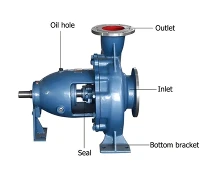
Product Knowledge: Submersible Sewage Pumps
1. What is a Submersible Sewage Pump?
A submersible sewage pump is a type of centrifugal pump designed to be fully submerged in liquid. It is specifically engineered to handle wastewater containing solids, fibers, sludge, and other debris that would clog a standard clean water pump. The pump and motor are hermetically sealed in a single waterproof housing, allowing it to operate underwater.
2. Key Components & Design Features
Motor: Typically an electric motor (single-phase or three-phase) enclosed in an oil-filled or air-filled chamber. It is equipped with a double mechanical seal to prevent liquid ingress.
Impeller: The heart of the pump. Sewage pumps use special impeller designs:
Vortex Impeller: Recessed behind the casing; creates a whirlpool effect. Best for handling large solids and fibrous materials with minimal clogging.
Grinder Impeller: Equipped with cutting blades to shred solids into a fine slurry before pumping. Used for pressurized sewer systems.
Single/ Multi-vane Impeller: Semi-open or closed design for higher efficiency but with moderate solids handling capability.
Casing: Heavy-duty cast iron or stainless steel, resistant to corrosion and abrasion.
Sealing System: Dual mechanical seals (often silicon carbide vs. carbon) with an oil chamber between them for lubrication and cooling. Some models include a moisture sensor in the oil chamber.
Cooling System: Submerged operation provides natural cooling. For dry-installed or high-temperature applications, a cooling jacket may be required.
Lifting Eye / Handle: For easy installation and removal from the sump.
3. Key Properties & Advantages
Fully Submersible: Operates reliably underwater, eliminating the need for priming (no air-lock issues).
High Solids Handling: Can pass spherical solids up to 50mm – 100mm diameter depending on model (e.g., 2-inch, 3-inch pass sizes).
Compact & Quiet: No above-ground pump house needed; operates with minimal noise.
Self-Priming: Since it's submerged, the pump is always primed.
Durable Construction: Corrosion-resistant materials, double mechanical seals, and thermal overload protection for long service life.
Automatic Operation: Can be equipped with float switches, level sensors, or control panels for fully automatic start/stop based on liquid level.
Energy Efficient: Modern permanent magnet motors (IE4/IE5) offer significant energy savings compared to older induction motors.
4. Common Applications
Municipal Sewage & Wastewater Treatment: Lift stations, transfer of raw sewage, sludge handling.
Building Drainage: Basement sewage ejector systems, stormwater collection, rainwater harvesting.
Industrial Effluent: Factories, food processing plants, textile mills, paper mills – handling process wastewater containing solids.
Construction & Mining: Dewatering of excavations, tunnels, and mine pits with muddy water.
Agricultural: Livestock waste pumping, irrigation drainage.
Flood Control & Emergency: Portable submersible pumps for flood water removal.
5. Installation Types
Wet Pit Installation: The most common – the pump is fully submerged in the liquid sump. Can be guide-rail mounted (for easy pull-out) or free-standing.
Dry Pit Installation: The pump is installed in a separate dry chamber adjacent to the wet well, but still connected to the suction pipe. Suitable for hazardous environments or when easy maintenance access is needed.
Portable / Submersible: Small, lightweight pumps with handles for temporary use in pits or flooded areas.
6. Standards & Markings
Look for markings indicating:
Manufacturer & Model
Power (kW / HP)
Voltage & Frequency (e.g., 380V/50Hz, 230V/60Hz)
Full Load Current (Amps)
Max Flow (m³/h or L/min)
Max Head (m)
Max Solid Size (mm)
Protection Class (IP68 – fully dust-tight and submersible)
Insulation Class (F or H)
Certifications: CE, UL, CSA, ATEX (for explosive environments)
Product FAQ – Submersible Sewage Pumps
Q1: What is the difference between a submersible sewage pump and a submersible drainage pump?
A:
Sewage pumps are designed to handle solids, fibers, and sludge. They have larger passages and clog-resistant impellers (vortex or grinder).
Drainage pumps (clear water pumps) handle clean or slightly dirty water with small particles (<5mm). They are not suitable for raw sewage or large solids.
Rule of thumb: If the water contains toilet paper, rags, or grit, use a sewage pump.
Q2: Can a submersible sewage pump run dry?
A: No. Running dry will quickly damage the mechanical seals and motor due to lack of cooling and lubrication. Most pumps have a thermal cut-out or dry-run sensor, but it is not guaranteed protection. Always ensure the pump is submerged during operation.
Q3: How do I choose the right size pump (Flow vs. Head)?
A: You need two parameters:
Required Flow (Q): How much liquid you need to move per hour (e.g., 20 m³/h).
Total Head (H): The vertical lift (static head) plus friction losses in pipes and fittings.
Select a pump whose performance curve shows the flow at your required head. Don't oversize – it wastes energy and may cause cavitation.
Q4: What does "max solid size" mean?
A: It indicates the maximum diameter of a spherical solid that can pass through the pump without clogging.
50mm (2") solid pass size is common for domestic sewage.
80mm – 100mm for industrial/municipal pumps.
If your wastewater contains larger objects, install a grinder pump or a bar screen upstream.
Q5: Why does my pump keep tripping the circuit breaker?
A: Common causes:
Overload: The pump is running at too high a head or flow (outside its design range).
Jammed impeller: A solid object is blocking rotation.
Electrical fault: Short circuit in winding or cable damage.
Thermal overload: Pump is running dry or motor is overheating.
Action: Check for blockages, verify voltage, and ensure the pump is submerged and operating within its curve.
Q6: How often should I service a submersible sewage pump?
A:
Routine check (every 3 months): Inspect cable, float switch, and sump condition.
Annual maintenance:
Check and replace mechanical seals if worn.
Inspect impeller for wear/damage.
Change oil in the oil chamber (if applicable).
Clean the pump body and sump of debris.
Major overhaul (every 3–5 years): Replace bearings, seals, and O-rings.
Note: In harsh environments (sand, chemicals), service intervals may be shorter.
Q7: Can I use a submersible sewage pump for clean water?
A: Technically yes, but it is inefficient. Sewage pumps have lower hydraulic efficiency than clean water pumps. For continuous clean water pumping, use a dedicated clean water pump (e.g., centrifugal end-suction). Sewage pumps are best kept for their intended duty.
Q8: What is a grinder pump and when do I need it?
A: A grinder pump has a cutting mechanism (shredder/grinder) that reduces solids to a fine slurry before pumping. It is used when:
The discharge pipe is small diameter (e.g., 1.25" – 2").
The sewage needs to be pumped long distances or uphill (high head).
You want to prevent clogs in a pressure sewer system.
Note: Grinder pumps consume more power and require periodic cutter replacement.
Q9: Why is my pump vibrating or making noise?
A: Possible causes:
Cavitation: Insufficient liquid supply (pump starved).
Unbalanced impeller: Debris stuck on blades or worn impeller.
Worn bearings: Bearing failure.
Loose mounting: The pump is not firmly seated on the guide rail or base.
Action: Stop the pump immediately, inspect and clear any blockages, check for wear.
Q10: Can a submersible sewage pump be installed horizontally?
A: Most submersible pumps are designed for vertical installation. Horizontal installation can cause:
Improper motor cooling.
Uneven seal wear.
Trapped air in the volute.
Check the manufacturer's manual. Some models are approved for horizontal use but require a specific orientation.
Q11: What is the difference between a single-phase and three-phase pump?
A:
Single-phase (220V/230V): Common for residential and small commercial applications. Usually has a built-in capacitor and thermal overload.
Three-phase (380V/400V/415V): Used for higher power (>2.2 kW). Requires a proper motor starter and overload protection. More efficient and smoother starting.
Note: Three-phase pumps can sometimes be run on single-phase via a Variable Frequency Drive (VFD) but consult the manufacturer.
Q12: How do I prevent my pump from clogging with rags or hair?
A:
Choose a pump with a vortex impeller – it is the most clog-resistant.
Install a bar screen or basket strainer at the sump inlet.
Use a grinder pump if fibrous materials are unavoidable.
Regular cleaning of the sump is essential.
Q13: What does IP68 mean?
A: IP68 is the highest ingress protection rating.
6: Dust-tight (no dust ingress).
8: Protected against continuous immersion in water beyond 1 meter depth (typically up to 10-20 meters depending on manufacturer specification).
All submersible sewage pumps should be at least IP68.
Q14: Can I use a submersible sewage pump in a flammable or explosive environment?
A: Only if the pump is ATEX (EU) or UL Class I Div I/II (USA) certified for hazardous locations. Standard sewage pumps are not explosion-proof and can cause ignition if used in areas with methane gas (common in sewers) or flammable vapors. Always use an explosion-proof pump in sewage lift stations where explosive gases may accumulate.
Q15: What maintenance should I perform before winter/storage?
A:
Drain all liquid from the pump and sump.
Clean the impeller and casing thoroughly.
Apply anti-corrosion spray to exposed metal parts.
Store the pump in a dry, frost-free environment.
If the pump will be idle for >3 months, rotate the shaft by hand periodically to prevent seal sticking.