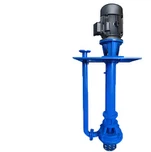
The submersible sewage pump is a type of pump where the pump and the motor are integrated and operate simultaneously underwater. Compared with ordinary horizontal pumps or vertical sewage pumps, the self-priming sewage pump is a new generation of pumps with a compact structure and small floor space.
The submersible sewage pump was successfully developed based on the usage characteristics of domestic pumps. It can tear and cut long fibers, bags, belts, grass, and cloth strips in the sewage, and then discharge them smoothly. It is particularly suitable for transporting liquids containing hard solids, fibers, and especially dirty, sticky, and slippery liquids. The submersible sewage pump has a unique effect in discharging solid particles and long fiber garbage.
The submersible sewage pump adopts a unique structure and a new type of mechanical seal, which can effectively convey liquids containing solid substances and long fibers. Compared with the traditional impeller, the impeller of this pump adopts a single-flow or double-flow form. It is similar to a pipe with the same cross-sectional size, which has excellent flow performance. Combined with a reasonable volute chamber, this pump has high efficiency and the impeller has undergone dynamic and static balance tests, ensuring no vibration during operation.
I. Submersible Sewage Pump · Advantages
Compared with ordinary horizontal pumps or vertical sewage pumps, submersible sewage pumps have the following obvious advantages:
1. Compact structure, small floor area. The submersible sewage pump operates underwater, so it can be directly installed in the sewage tank without the need for a separate pump room for installing the pump and the motor. This can save a significant amount of land and construction costs.
2. Easy to install and maintain. Small sewage pumps can be installed freely, while large sewage pumps usually come with an automatic coupling device, allowing for automatic installation. Installation and maintenance are very convenient.
3. Long continuous operation time. The sewage pump, due to the coaxiality of the pump and the motor, short shaft and light weight of the rotating components, the load (radial) borne by the bearings is relatively small. Therefore, its service life is much longer than that of ordinary pumps.
4. There is no issue of cavitation damage or water backflow. Especially the latter point has brought great convenience to the operators.
It is precisely because of these advantages that submersible sewage pumps have been receiving increasing attention from people and their application scope has been expanding. They are no longer merely used for transporting clean water but can now handle various types of domestic sewage, industrial wastewater, construction site drainage, liquid feed, and so on. They play a very important role in various industries such as municipal engineering, industry, hospitals, construction, restaurants, and water conservancy construction.
II. Disadvantages of Submersible Sewage Pumps
For submersible sewage pumps, the most critical issue is the reliability problem. This is because the pumps are used in a liquid environment; the medium they convey is a mixture of some solid materials and liquids; the pump is very close to the motor; the pump is vertically installed, and the weight of the rotating components is in the same direction as the water pressure borne by the impeller.
These issues all make the requirements for the sewage pump in terms of sealing, motor capacity, bearing arrangement and selection higher than those of ordinary sewage pumps.
III. Development of Submersible Sewage Discharge Pumps
To enhance the lifespan of submersible sewage discharge pumps, most manufacturers worldwide have been exploring solutions in the pump's protection system. That is, when the pump experiences faults such as leakage, overload, or overheating, it can automatically trigger an alarm and automatically shut down for maintenance.
However, we believe that it is very necessary to install a protection system in the sewage pump. This system can effectively ensure the safe operation of the electric pump. But this is not the crux of the matter. The protection system is merely a remedial measure taken after the pump malfunctions, and it is a relatively passive approach. The key issue should be to start from the fundamental level and completely solve the problems of the pump in terms of sealing and overload, which would be a more proactive solution.
Therefore, we applied the peripheral vane rotor body dynamic sealing technology and the pump's overload-free design technology to the submersible sewage pump, which significantly improved the pump's sealing reliability and load-bearing capacity, and extended the pump's service life.
IV. Submersible Sewage Pump - Sealing Technology
The so-called auxiliary vane flow body dynamic sealing refers to installing an open vane wheel coaxially in the opposite direction on the back of the pump's impeller cover plate. When the pump is operating, the auxiliary vane wheel rotates along with the main shaft of the pump, and the liquid in the auxiliary vane wheel also rotates together. The rotating liquid generates an outward centrifugal force, which, on the one hand, resists the liquid flowing towards the mechanical seal area, thereby reducing the pressure at the mechanical seal area.
On the other hand, it prevents solid particles in the medium from entering the friction surfaces of the mechanical seal, reduces the wear of the mechanical seal's friction blocks, and extends their service life.
The secondary impeller not only serves the function of sealing, but also can play a role in reducing axial force. In submersible sewage pumps, the axial force mainly consists of the pressure difference force exerted by the liquid on the impeller and the gravity of the entire rotating part. The directions of these two forces are the same, and their resultant force is the sum of the two forces.
It can be seen that, under the condition of identical performance parameters, the axial force of submersible pumps is greater than that of ordinary horizontal pumps, and the balancing difficulty is also greater than that of vertical pumps.
Therefore, in submersible pumps, the reason why the bearings are prone to damage is also closely related to the large axial force. And if a secondary impeller is installed, the pressure difference force exerted by the liquid on the secondary impeller is in the opposite direction to the combined force of the above two forces. This can counteract a part of the axial force, thereby playing a role in extending the service life of the bearings.
However, there is also a drawback to using the secondary impeller sealing system, which is that a certain amount of energy needs to be consumed on the secondary impeller, typically around 3%. But as long as the design is reasonable, this loss can be minimized to the lowest level.
V. Submersible Sewage Pump - Design Technology
In a typical centrifugal pump, the power always increases as the flow rate increases. That is to say, the power curve is a curve that rises as the flow rate increases. This poses a problem for the use of the pump:
When the pump operates at the design point, generally speaking, the power of the pump is less than the rated power of the motor, and thus the use of this pump is safe; however, when the pump's head decreases, the flow rate will increase (as can be seen from the pump's performance curve), and the power will also increase accordingly.
When the flow rate exceeds the design flow rate and reaches a certain value, the input power of the pump may exceed the rated power of the motor, causing the motor to overheat and burn out.
When the motor is overloaded, either the protection system will act to stop the pump from rotating; or the protection system will fail, causing the motor to burn out.
The situation where the pump's head is lower than the designed operating point head is quite common in practice. One scenario is that during pump selection, the pump's head is set too high, but it is actually used with a reduced head; another situation is that the operating point of the pump is difficult to determine during use, which means the flow rate of the pump needs to be frequently adjusted; yet another situation is that the pump needs to be used at different locations frequently.
These three situations may cause the pump to overwork and affect its reliability. It can be said that for pumps without full head characteristics (including sewage pumps), their application range will be greatly restricted.
The so-called full-flow characteristic (also known as no-overload characteristic) refers to the fact that the speed at which the power curve rises as the flow increases is extremely slow. Ideally, when the flow increases to a certain value, the power will not continue to rise but will instead decrease. That is to say, the power curve is a curve with a hump. If this is the case, we only need to select the motor's rated power to be slightly higher than the power value at the hump point. Then, within the entire range from 0 flow to maximum flow, no matter at which operating point the pump is running, the power of the pump will not exceed the motor power and thus will not cause the pump to overload. For pumps with this performance, both selection and use will be very convenient and reliable.
In addition, the motor power does not need to be set too high, which can also help save considerable equipment costs.
Use the editor
The drainage pumps used in buildings include submersible sewage pumps, submerged drainage pumps, vertical sewage pumps and horizontal sewage pumps, etc. Due to the generally small space and small drainage volume in buildings, submersible sewage pumps and submerged drainage pumps can be given priority for use. Among them, submerged sewage pumps are usually used in important places. Vertical sewage pumps and horizontal sewage pumps require seismic isolation foundations, self-priming suction, and occupy a certain amount of space, so they are less used in buildings.
VI. Submersible Sewage Discharge Pumps · Types
1. Large-diameter non-clogging submersible sewage discharge pump
2. Automatic cutting of fabric strips with a knife, automatic mixing of weeds, and automatic sewage pumping for underwater disposal
3. The pump body is installed at the water edge and is a self-priming sewage pump.
4. Submersible sewage pump - The pump body can be submerged in the raw material.
5. Mortar pumps with excellent anti-corrosion and wear-resistant properties are also a type of sewage pumps.
VII. Submersible Sewage Pump · Usage
Industrial wastewater discharge.
2. Urban sewage treatment plant discharge system.
3. Subway, basement, and civil defense system drainage stations.
4. Sewage discharge from hospitals, hotels and high-rise buildings.
5. Sewage treatment station in the residential area.
6. Municipal engineering, the discharge of slurry from construction sites.
7. Water supply equipment of the water treatment plant.
8. Sewage discharge from livestock farms and irrigation of rural farmland.
9. Exploration of mines and water treatment equipment supply.
10. Instead of carrying or transporting by hand, the river mud is suctioned and transported.
11. Operating conditions: water temperature ≤ 60℃, liquid pH value is 4 to 10.
VIII. Features of Submersible Sewage Pumps
By adopting a unique single or double impeller structure, the throughput capacity of impurities has been significantly enhanced. It can effectively pass through substances with a diameter 5 times that of the pump's diameter and solid particles with a diameter approximately 50% of the pump's diameter.
2. The mechanical seal is made of a new type of hard and corrosion-resistant tungsten titanium material, which enables the pump to operate safely and continuously for more than 8,000 hours.
3. The overall structure is compact, the volume is small, the noise is low, the energy-saving effect is remarkable, maintenance is convenient, no pump room needs to be built, and it can work underwater directly, significantly reducing the project cost.
4. In the sealing oil chamber of this pump, there is a high-precision anti-interference water leakage detection sensor. Heat-sensitive elements are pre-installed in the stator winding to automatically protect the pump motor.
5. According to the user's requirements, a fully automatic control cabinet can be equipped. This control cabinet can automatically protect the pump from water leakage, electric leakage, overload and overheating, thereby enhancing the safety and reliability of the product.
6. The float switch can automatically control the start and stop of the pump according to the changes in liquid level. It does not require constant supervision by a person and is extremely convenient to use.
7. The sewage pump can be equipped with a dual-guide rail automatic coupling installation system according to the user's requirements. This system provides greater convenience for installation and maintenance, and people do not have to enter the sewage pit for this purpose.
8. It can be used throughout the entire operating range while ensuring that the motor does not overheat.
There are two different installation methods: the fixed automatic coupling installation system and the freely movable installation.
IX. Discharge Pump for Underwater Use · Precautions
When the humidity sensor or temperature sensor gives an alarm, or when abnormal vibrations or noises occur during the operation of the pump body; or when the output water volume or water pressure decreases, and the power consumption significantly increases, the submersible sewage pump should be immediately shut down for maintenance.
2. For some pumps with poor sealing, even if they are not in use, their insulation value will gradually decrease over time. Eventually, they will be unable to be put into operation, and in some cases, insulation failure may occur within a shorter period of time than the continuous operation of a submerged sewage pump in water. Therefore, having a standby pump in the suction tank sometimes does not serve as a true standby. If conditions permit, it is advisable to have a dry standby outside the tank. When a certain submerged pump in operation fails, immediately shut it down, lift it up, and then put the standby pump back down.
3. The submersible pump should not be started and stopped too frequently, as this will affect its service life. When the submersible pump stops, water in the pipeline will flow back. If it is restarted immediately at this point, it will cause the pump to be overloaded when starting and endure unnecessary shock loads; moreover, frequent starting and stopping of the submersible pump will damage components with poor shock resistance and lead to the overall damage of the electric pump.
4. After the machine has stopped, it must not be restarted until the motor has completely stopped rotating.
5. When inspecting the electric pump, the power supply must be cut off.
When the submersible pump is in operation, do not wash items, swim or let livestock enter the water nearby, as this may lead to an electric shock accident if the pump leaks electricity.