The difference between double-suction pumps and single-suction pumps
The double-suction pump and the single-suction pump are two forms of pumps used for liquid transportation. Although their basic functions are both to transport liquid from one place to another, there are significant differences in their design, working principle, and applicable scenarios. Understanding these differences can help in choosing the appropriate pump for different situations.
Characteristics of the double-suction pump
The unique feature of the double-suction pump lies in its impeller design. It consists of two impellers placed back-to-back, allowing the water flowing out from the impellers to smoothly merge into the volute. After structural optimization, the double-suction pump, with its outstanding head and flow rate, has been widely used in engineering projects. It is worth noting that the double-suction pump has two suction chambers. Although many people might mistakenly think that one is the water inlet and the other is also the water inlet upon first sight, in fact, both chambers are located below the axis and are connected to the suction inlet. This design enables the double-suction pump to effectively reduce the inlet flow rate under the same speed and flow conditions, thereby reducing the risk of cavitation.
Characteristics of the single-suction pump
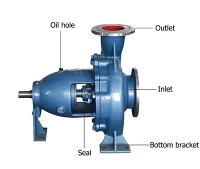
The design of the single suction pump is unique. Its characteristic of horizontal axial suction enables the fluid to be smoothly discharged radially upwards. This pump adopts a suspended structure, which greatly facilitates maintenance. Without the need to dismantle the inlet and outlet pipelines, the rotor components can be easily removed for maintenance. Additionally, the single suction pump is connected to the motor through a common elastic coupling or an extended elastic coupling, ensuring efficient and stable transmission. In terms of shaft sealing, the pump uses a soft packing seal, ensuring the reliability of the sealing performance. Meanwhile, the single row radial ball bearings are lubricated with lubricating oil, further extending the service life of the bearings. From the motor end, the rotation direction of the single suction pump is clockwise. This design makes the pump more stable and efficient during operation.
The differences between the two pumps
The working principles of double-suction pumps and single-suction pumps are different. Although both types of pumps rely on the rotation of the impeller to convey liquids, the design of the double-suction pump is unique. Its impeller has suction ports on both sides, allowing it to suck in liquids from two directions simultaneously. This design not only increases the liquid flow but also enhances the pump's stability. In contrast, the single-suction pump has only one suction port, resulting in slightly inferior flow and stability compared to the double-suction pump. However, the single-suction pump has a simpler structure and is easier to maintain, so it still has significant advantages in certain application scenarios.
Differences in water intake methods
The design feature of a single-suction pump is that the impeller only takes in water at one end, while a double-suction pump is different. Its impeller has inlet ports at both ends, meaning it has two inlets. This difference in design directly affects the flow rate and stability of the two types of pumps.
Flow difference
The double-suction pump performs even better in situations where a large flow rate is required and stable operation is demanded. For high flow requirements, a single-suction pump needs a larger pump inlet and outlet diameter, and its rotational speed needs to be controlled at approximately 1450 rpm to maintain stability. However, the double-suction pump can achieve an increase in volumetric efficiency with a smaller size and weight, as well as a higher rotational speed.
Anti-cavitation capability
Compared to single-suction pumps, double-suction pumps have better anti-cavitation performance. This is because the medium is symmetrically sucked at both ends of the impeller, creating a hydraulic balance, which enables double-suction pumps to perform better in balancing the axial thrust and ensuring the stability of their operation. Additionally, the lower flow rate of the medium reduces the possibility of cavitation in the impeller. Cost variance
The manufacturing cost of a double-suction pump is relatively higher, so its price is often slightly higher than that of a single-suction pump. However, although single-suction pumps are more affordable in terms of cost and widely used, in certain specific working conditions, the performance of a double-suction pump may be more outstanding. Therefore, when making a choice, users should make decisions based on their actual operational needs.