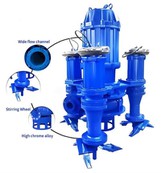
Products Description

The selection of material types for slurry pumps is not an exact science; it depends on empirical data and the experience of engineers. Generally speaking, the material selection process needs to take into account all the variable characteristics of the specific slurry and is constrained by the following factors:
The type of pump;
Tip speed of the impeller (circular speed);
The structure of the products within the range of available pump models.
The basic data required for selecting the materials are as follows:
The particle size distribution of solids in the medium;
The shape and hardness of the solid.
Corrosivity of the liquid component;
Operating temperature.
The selection of materials for the inner liner of the pump and the impeller usually falls within two basic categories:
Elastomer;
Wear-resistant/Corrosion-resistant casting alloy;
Ceramics.
Introduction
II. Elastomer
The commonly used elastomers in slurry pumps can be classified into three categories: natural rubber, polyurethane and synthetic elastomers.
Natural rubber
When natural rubber is used as a lining material, it exhibits excellent erosion resistance for solid particles with a diameter of 12mm (1/2 inch). However, when applied to impellers, its resistance to particles with a diameter exceeding 6mm (1/4 inch) significantly decreases. Additionally, natural rubber has limited adaptability to media containing sharp solids. Nevertheless, the new anti-cutting formulation has to some extent improved this defect. Due to its relatively soft texture, natural rubber is prone to being cut or torn by large-sized solids or debris. When used in grinding circuits (such as ball mills, semi-autogenous grinding mill drums, and grinding machine water collection pits vibrating screens), the regulation of screen hole size and the condition of the screen media is a key factor to ensure its stable operation.
Natural rubber has a unique lagging recovery failure mode, where the accumulation of internal heat can trigger thermal decomposition and desulfurization reactions, resulting in a sharp decline in mechanical properties. To avoid this risk, the circumferential speed of the impeller is usually controlled below 27.5 m/s (5400 ft/min) to prevent thermal degradation in the area of the suction liner near the outer edge of the impeller.
Natural rubber has poor tolerance to oils, solvents and strong acids. After contact, it is prone to significant volume expansion, reduced wear resistance and substantial decrease in mechanical strength. Moreover, it is not suitable for applications where the fluid temperature exceeds 75℃. For chemical substances or high-temperature environments, synthetic elastomers need to be used, and specific types should be selected based on the combination of the specific chemical medium and operating temperature.
2. Polyurethane
Polyurethane, as a type of synthetic elastomer, is formed by mixing two liquid chemicals and then curing after pouring. This material exhibits excellent resistance to fine solid particles and performs better than natural rubber in some application scenarios.
Although not a typical material resistant to chemical corrosion, polyurethane still exhibits significantly better chemical expansion resistance than natural rubber. In scenarios such as flotation circuits containing various chemicals, its service life can be much longer than that of natural rubber. Moreover, polyurethane can be used as the pump liner for impellers with a rotational speed of more than 27.5 m/s (5400 ft/min) (in this condition, natural rubber is no longer applicable), and it is also suitable for occasional scenarios where debris may damage the rubber impeller.
Due to the fact that the Shore hardness of polyurethane is usually higher than that of conventional natural rubber, its performance may be limited when dealing with rough and sharp particles. Such particles are prone to cause peeling on its surface. Additionally, the chemical structure of polyurethane makes it susceptible to "hydrolysis" (a specific failure mode of elastomers), especially when exposed to strong acids or strong bases; however, through specific formulation improvements, its resistance to hydrolysis can be significantly enhanced. The upper limit of polyurethane's applicable temperature is 70℃, and it will be degraded by hydrocarbons.
3. Synthetic Elastomer
In the synthesis of elastomer compounds, the polymer component of natural rubber is replaced by specially formulated polymers. These specially formulated polymers can withstand specific chemical environments or operating temperatures. This modification process usually requires the use of new reinforcing agents, curing agents, and other specialized additives that are compatible with the selected synthetic rubber.
Although synthetic elastomers outperform natural rubber in terms of chemical resistance and heat resistance, there is a fundamental trade-off: their wear resistance is usually lower than that of the naturally rubber with optimized formulation. These characteristic differences arise from the prioritization considerations in material design - synthetic elastomers enhance their environmental adaptability through molecular structure regulation, but compromise in their frictional properties. This provides a crucial basis for material selection in specific working conditions, namely, a targeted balance needs to be struck between environmental tolerance and wear resistance.
III. Wear-resistant/Erosion-resistant Casting Alloys
The wear-resistant casting alloy is suitable for the inner liner and impeller of slurry pumps and can operate in scenarios where rubber materials are inadequate, including those with large or sharp particles, high head (high impeller rotational speed), high operating temperatures, and those rich in hydrocarbons.
In the application of centrifugal pump slurry, high-chromium white iron is the most commonly used alloy series. This type of alloy is based on iron, with metal carbides accounting for 15% to 55% of the volume, uniformly dispersed within it. These carbides can have a hardness of over 1200HV, giving the alloy excellent erosion resistance. However, the presence of hard carbides leads to a decrease in the material's toughness and comprehensive mechanical properties - high-chromium white iron is prone to brittle fracture when subjected to impact. Currently, through in-depth research on this type of material and continuous optimization of the design of slurry pumps, the failure caused by brittle fracture can be effectively alleviated.
High-chromium cast white iron can meet the requirements of most working conditions and has good tolerance to various chemicals. However, due to its insufficient acid resistance, most products are only suitable for environments with a pH greater than 4. For highly erosive acidic conditions with a pH of 1 or less, although there are dedicated high-chromium cast white iron options available, their wear resistance is slightly lower than that of traditional models.
For scenarios with pure corrosive conditions or those requiring special impact resistance, cast steel and nickel alloy series can be selected. In extremely light slurry where the medium is extremely corrosive, duplex stainless steel or austenitic stainless steel can be used; for the slurry with the strongest corrosiveness, nickel-based alloys need to be chosen. It should be emphasized that these steels and nickel alloys are not designed for wear resistance. Their corrosion resistance improvement is usually at the expense of wear resistance, so they are generally not recommended for scenarios involving erosive solids.
IV. Ceramics
The commonly used ceramics in slurry pumps can be classified into three categories: polymer-based ceramics, functional ceramics. Ceramic materials have excellent corrosion resistance and wear resistance, but they have long production cycles and high processing difficulties, resulting in relatively high production costs.
Polymer-based ceramics
Epoxy composite ceramics: Based on epoxy resin, they possess excellent adhesion, corrosion resistance, and dimensional stability. Oxide aluminum and silicon carbide particles, along with short-cut fibers, are used as ceramic reinforcing phases. After curing, they form a composite material with high strength and hardness, having better chemical corrosion resistance than polyurethane-based materials, and moderate impact resistance. They are commonly used for the inner lining coating of slurry pumps or local wear-resistant components (such as the inner lining of pump casings and the edges of impellers), especially in slurry environments with medium concentration of acidic or alkaline chemical media.
Vinyl composite ceramics: Vinyl resin combines the toughness and chemical resistance of epoxy resin, as well as the curing property of unsaturated polyester. With alumina, silicon carbide, etc. as reinforcing phases, combined with ceramic fibers/whiskers, the material's impact resistance and tear resistance are significantly enhanced. Suitable for slag slurry treatment scenarios with medium particle size and complex chemical environments.
Polyurethane-based composite ceramics: Using polyurethane (PU) as the matrix, common hard ceramic particles such as aluminum oxide (Al₂O₃), silicon carbide (SiC), and zirconia (ZrO₂) are used as ceramic reinforcing phases. Through the dispersion strengthening of the ceramic particles, the wear resistance and impact resistance of polyurethane are significantly enhanced, while the flexibility of polyurethane is retained, enabling it to resist erosion and wear caused by fine to medium-sized solid particles. It is suitable for scenarios involving chemical media or medium wearability slurry, such as flotation circuits and tailings transportation. Especially when replacing traditional natural rubber, it can balance both chemical resistance and wear resistance.
2. Functional Ceramics
Alumina ceramic (Al₂O₃ ceramic): Alumina ceramic is the earliest functional ceramic applied in slurry pumps. The higher its hardness and wear resistance, and its chemical performance stability (except strong alkaline solutions and hydrofluoric acid), the lower the cost. It is commonly used for the inner lining, protective sleeve, and local wear-resistant layer of the impeller of slurry pumps, especially suitable for handling medium wear intensity slurry, but it has a higher brittleness and poorer impact resistance.
Silicon carbide ceramics (SiC ceramics): Silicon carbide ceramics (especially reaction-sintered SiC and pressure-free sintered SiC) have extremely high wear resistance, excellent corrosion resistance (not resistant to hydrofluoric acid and strong oxidizing acids), good thermal conductivity, high temperature resistance, and superior thermal shock resistance compared to alumina ceramics. They are suitable for high-maintenance, strong-corrosion or high-temperature slurry conditions, such as high-concentration slurry containing sharp particles (such as quartz sand, metal slag), or acid/alkali-containing chemical slurry. They are often used as core wear-resistant components such as impellers, front guard plates, and wear rings of slurry pumps.
Zirconia toughened ceramics (ZrO₂ ceramics): These ceramics are toughened by stabilizers such as yttrium oxide (Y₂O₃), and possess extremely high fracture toughness (3-5 times that of alumina ceramics) and wear resistance. They have high hardness (Mohs hardness ranging from 8.5 to 9 grades) and excellent corrosion resistance (except for hydrofluoric acid): They are suitable for applications where particles in the slurry have a certain degree of impact (such as coarse particle slag, sand, and gravel), and can be used for components like impellers and wear-resistant liners, compensating for the brittleness of traditional ceramics and performing more stably in medium wear intensity and impact-resistant conditions.
V. Introduction to the Application of Warman Material System
Code
Material Name
Type
Function Description
A04
ULTRACHROME® 24% Chromium Corrosion-Resistant Gray Iron
White cast iron
A04 alloy is a type of white iron specially designed for drilling and tapping operations. The corrosion resistance of A04 is not as good as that of A05 and it is usually not corrosion-resistant. A04 is used for sealing adapters, stuffing boxes and discharge devices.
A05
ULTRACHROME® 27% Chromium Corrosion-Resistant Gray Iron
White cast iron
A05 alloy is a kind of wear-resistant white cast iron, which performs exceptionally well under various erosion conditions including mild corrosive environments. The high wear resistance of A05 is attributed to the presence of hard carbides in its microstructure.
A25
Ni-Cr-Mo steel
Cast steel
A25 alloy is a type of alloy steel with moderate wear resistance and high mechanical properties. This alloy is used for large castings where toughness is of utmost importance, such as the pump casing for gravel.
A49
ULTRACHROME® 28% Chromium Low Carbon High-Chromium Low-Carbon White Iron
White cast iron
A49 alloy is a corrosion-resistant white cast iron that is suitable for low pH corrosive conditions. However, it also has the problem of erosion wear. This alloy is particularly suitable for flue gas desulfurization (FGD) and other moderately corrosive slurry applications.
A53
ULTRACHROME® Austenitic Stainless Steel High-Chromium White Iron
White cast iron
A53 alloy is a high corrosion-resistant alloy with moderate corrosion resistance. A53 can be used in low pH applications, such as phosphate conditions or certain sulfur dioxide removal applications, where erosion issues also exist.
A61
HYPERCHROME® 30% Cr High Chromium White Iron
White cast iron
The A61 alloy is a hypereutectic white cast iron. Due to the presence of a high volume fraction of hard and wear-resistant chromium carbides in the alloy matrix, it possesses extremely high corrosion resistance.
A68
HYPERCHROME® 30% Cr High Chromium White Iron
White cast iron
A68 alloy is a hypereutectic white iron. It is suitable for high wear conditions and has mild corrosion resistance. It should be used in applications where similar corrosion resistance to Ultrachrome A05 alloy and better wear resistance level than Hyperchrome® A61 alloy are required.
A241
ULTRACHROME® 32% Chromium High Chromium White Iron
White cast iron
A241 alloy is a wear-resistant and impact-resistant white cast iron. It has been optimized for applications where impact causes material loss. Compared with A61, A241 has excellent impact resistance, and compared with A05, it has excellent corrosion resistance.
C21
13% chrome steel
Martensitic stainless steel
C21 alloy is a fully hardened 420C stainless steel.
C23
CF-8M Stainless Steel
Austenitic stainless steel
C23 alloy is CF-8M stainless steel. C23 has excellent corrosion resistance, but its resistance to corrosion is poor. It is the casting equivalent of 316SS.
C26
CD-4MCuN Stainless Steel
Duplex stainless steel
C26 alloy is a CD-4M CuN duplex stainless steel. It is more corrosion-resistant than C23, but usually has poorer corrosion resistance. This is the casting equivalent of 2205SS.
D21
Spheroidal graphite cast iron (SG iron)
Cast iron
D21 alloy is a grade of ductile iron with grayish color, and is used as the standard material for pump casings and frames.
D25
High-strength ductile iron (SG iron)
Cast iron
D25 alloy is a proprietary ductile iron, used for high-pressure vessels that require the highest mechanical strength.
N02
63% Ni 30% Cu alloy
Corrosion-resistant nickel alloy
N02 alloy is a nickel-copper alloy that is suitable for corrosive environments but has poor wear resistance. N02 is also known as Monel alloy.
N22
58N 22Cr 12Mo alloy
Corrosion-resistant nickel alloy
N22 is an extremely corrosion-resistant alloy, used in extremely harsh applications that even austenitic and austenitic superalloy cannot withstand. N22 is also known as Hastelloy® C-22®.
J32
70% tungsten carbide coating 420SS
Ceramic-coated stainless steel
J32 is a metal-ceramic composite coating, composed of 70% tungsten carbide and 420 stainless steel substrate. It is used for shaft sleeves in corrosive conditions.
J37
70% tungsten carbide coating CD4-MCUN
Ceramic-coated duplex stainless steel
J37 is a metal-ceramic composite coating, composed of 70% tungsten carbide and a duplex stainless steel substrate. It is used for shaft sleeves in corrosive and abrasive conditions.
J39
80% tungsten carbide coating 420SS
Ceramic-coated stainless steel
J39 is a metal-ceramic composite coating, composed of 80% fine-grained tungsten carbide and 420 stainless steel substrate. It is used for shaft sleeves under extremely abrasive conditions and has higher wear resistance compared to J32.
R35
Linatex® Premium Rubber
Natural rubber
R35 Linatex premium is a soft and highly elastic natural rubber that has been optimized for fine particle slurry abrasion applications.
R55
The discharge lining of the mill is made of natural rubber.
Natural rubber
R55 natural rubber is a compound specifically designed to address the common wide slurry distribution in the discharge applications of grinding machines.
R508
The discharge lining of the mill is made of natural rubber.
Natural rubber
R508 natural rubber is a compound specially designed for the most demanding applications, featuring extremely high tear resistance and tensile strength.
S01
EPDM rubber
Synthetic elastomer
S01 is a synthetic elastomer with excellent acid resistance and ozone resistance. It is mainly used in sealing applications due to its low compressive permanent deformation property.
S12
Nitrile rubber
Synthetic elastomer
S12 is a type of synthetic rubber commonly used in applications involving fats, oils and waxes. S12 has moderate corrosion resistance.
S21
Butyl (IIR) rubber
Synthetic elastomer
The S21 synthetic rubber exhibits excellent chemical stability, good heat resistance and oxidation resistance, but has poor corrosion resistance. S21 is used in acidic environments.
S31
Chlorosulfonated polyethylene
Synthetic elastomer
S31 is an antioxidant and heat-resistant elastomer. It has excellent chemical stability towards acids and hydrocarbons.
S42
Polybutadiene
Synthetic elastomer
S42 is a high-strength synthetic elastomer with dynamic performance only slightly lower than that of natural rubber. S42 has excellent temperature resistance and oil resistance. It is usually used in situations where hydrocarbon-based natural rubber degrades.
S51
Fluorosilicone polymer
Synthetic elastomer
The S51 synthetic elastomer exhibits excellent resistance to oils and chemicals at high temperatures, but has poor corrosion resistance.
U38
Wear-resistant polyurethane
Polyurethane elastomer
U38 is an erosion-resistant material that performs well in elastomer applications and is suitable for "impurity" issues. This is attributed to U38's high tear and tensile strength. However, its erosion resistance is not as good as that of natural rubber (R55ª rubber).
Y08
Silicon nitride combined with silicon carbide
Ceramics
Y08 is a wear-resistant ceramic that performs well in fine particle wear applications, but has poor resistance to solid impacts and erosion greater than -1mm.
Hot Tags: municipal engineering slurry pump for sewage sludge conveying, China municipal engineering slurry pump for sewage sludge conveying manufacturers, sump slurry pump for rock laden slurry, sump slurry pump for inorganic slurry, sump slurry pump for meitnerium mining, sump slurry pump for bohrium mining, sump slurry pump for colloidal slurry, sump slurry pump for dairy factories