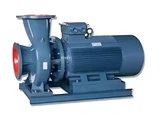
Products Description

Vertical Inline Centrifugal Pumps
If you are tired of vertical pumps that develop a "hum" after two months or start weeping at the seal as soon as the pressure spikes, let's talk about the actual build quality. Most buyers look at the flow and head on the nameplate, but the real difference is in the stuff the factory usually tries to hide.
Here's a breakdown of what we're actually putting into our ISG/IRG series.

The Impeller: Precision Casting vs. Sand Casting
Most "budget" pumps use sand-cast impellers. The internal vanes are rough, which causes turbulence and kills your efficiency. We use investment casting (lost-wax process). This gives the internal flow channels a smooth-as-glass finish.
The Benefit: Less friction loss means you get the rated flow without the motor drawing extra amps. It also prevents "cavitation pitting" that usually eats up cheap impellers in high-speed circulation.
The Shaft: One-Piece 2Cr13 vs. Carbon Steel Sleeves
A common cost-cutting trick is to use a cheap carbon steel shaft and put a thin stainless sleeve over the seal area. This is a disaster waiting to happen-the shaft eventually rusts and seizes under the sleeve. We use a solid, one-piece 2Cr13 (or SS304/316) hardened shaft.
The Benefit: No vibration at high RPMs and zero risk of the shaft snapping during a hard start. It keeps the mechanical seal perfectly centered, which is the only way to get a 10,000+ hour seal life.


Motor Copper: The "Hidden" Under-sizing
You'll see many pumps labeled "2.2kW" that weigh 5kg less than ours. That's because they're using aluminum wire with a copper coating or just less copper altogether. We use 100% pure copper windings with Class F insulation, plus cold-rolled silicon steel for the stator.
The Benefit: Our motors don't run hot. In an enclosed basement pump room with poor ventilation, a "cheap" motor will trip the thermal overload every afternoon. Ours won't.

The Seal Chamber's Air Vent Hole
This is a small detail that 90% of factories miss. On a vertical pump, the mechanical seal is at the top. If air gets trapped there, the seal runs dry and burns out in minutes. We've machined a specific venting bypass that ensures the seal faces are always submerged in the pumped liquid.
The Benefit: You don't have to worry about your installers forgetting to manually bleed the air every time they restart the system.

HT200 Casing with Electrophoretic Coating
Look at a pump after a year in a humid environment. If it's covered in red rust, it's because it was just spray-painted. We put our HT200 cast iron casings through electrophoretic coating (E-coat) before the final paint.
The Benefit: It's the same rust-proofing used on car frames. Even if the pump is handling condensation or is installed in a damp utility tunnel, the casing won't pit or corrode.
.


Hebei Jingweida Technology Co., Ltd. is a large-scale enterprise specializing in the production of slurry pumps. It has a large-scale test pump station with testing accuracy reaching international standards, capable of independently completing the development and research of new products for water pumps and materials, and ensuring the provision of the best products and materials suitable for various working conditions.
The company's specialized production equipment and international manufacturing level have created a favorable development platform for the enterprise. It not only has stable cooperative relationships with many well-known domestic and listed companies such as waterway authorities and mining companies, but also extensively cooperates with a large number of world-renowned multinational companies. Its product range covers pumps and accessories, OEM and custom processing, etc. The products are exported to regions such as North America, South America, Africa, Europe, and Southeast Asia.
The company's product system comprehensively covers the core areas of slurry pumps, mainly including: heavy-duty slurry pumps suitable for high-strength abrasive working conditions, light-duty slurry pumps suitable for common wear scenarios, corrosion-resistant pump series customized for special industries and mines, and a complete set of accessory systems covering various vulnerable parts. These products deeply serve important fields such as mining and beneficiation, power and metallurgy, dredging and waterways, chemical industry, and municipal environmental protection, providing durable and reliable solutions for harsh working conditions with high abrasion and corrosion.
All products strictly follow international CE certification standards and Chinese national standards, ensuring that each product has excellent quality assurance and safety reliability. Jingweida Technology is always your reliable partner in harsh working conditions.
FAQ
Q: The pump arrived and the shaft is hard to turn by hand. Is it seized?
A: No. That's actually a good sign. It means the mechanical seal spring tension is set correctly and the bearings are packed with high-viscosity grease. Once you prime the pump with water, the seal faces lubricate and it will spin freely. Don't try to force it with a pipe wrench; you'll chip the seal faces.
Q:Can I use this for a VFD system to save power?
A: Yes, but don't drop below 30Hz. Standard motor fans are "shaft-driven," so if you run at 15Hz or 20Hz, the fan won't move enough air to cool the motor. If you need to run at ultra-low speeds, let us know and we'll swap it for a motor with an independent electric cooling fan.
Q:My discharge pipe is 80mm, but your pump flange is 50mm. Can I just use an expander?
A: You can, but you'll lose pressure. If your pipe is much larger than the pump outlet, the velocity drops and you might get sediment buildup in your lines. Always try to match the pump's outlet velocity (usually 2-3 m/s) to the pipe size for the best efficiency.
Q:We're pumping water at 95°C. Is the standard ISG okay?
A: No. Standard ISG seals are rated for 80°C. For 95°C, you need our IRG configuration. We swap the Viton O-rings for high-temp EPDM and use a mechanical seal with a heat-resistant stationary seat. If you use a cold-water pump for boiling water, the seal will fail within 48 hours.
Q:Why does the pump sound like it's pumping "gravel" even though the water is clean?
A: That's cavitation. Your suction pipe is likely too small or your suction lift is too high. The pump is literally tearing the water apart. Open the suction valve fully or shorten the suction line. If you keep running it like that, you'll find a hole in your impeller within six months.
China's expert in one-stop service for pump manufacturers
Our address
Baoding Cloud Center, Hebei, China
Phone Number
+86 150 7625 8596
admin@jovidiapump.com

Hot Tags: vertical inline centrifugal pumps, China vertical inline centrifugal pumps manufacturers