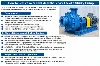
What Is a Slurry Pump?
A slurry pump is a centrifugal pump designed to transport liquids containing suspended solid particles.
Depending on the application, slurry pumps can be used for mineral processing, tailings transfer, sand handling, coal preparation, dredging and other heavy-duty applications.
The pump must be selected according to both the hydraulic requirements and the characteristics of the slurry.
Why Do Mining Applications Require Heavy-Duty Pumps?
Mining slurry can be highly abrasive. Solid particles continuously pass through the pump's wet end and can gradually wear the impeller, casing, liner and other components.
The severity of wear depends on several factors, including:
Particle size
Particle concentration
Particle hardness
Slurry density
Pump speed
Operating hours
A pump operating continuously in an abrasive environment requires appropriate materials and hydraulic design.
Key Factors When Selecting a Slurry Pump
1. Flow Rate
Determine the required slurry flow rate in m³/h.
The pump should be selected according to the actual operating point rather than the maximum flow shown in a catalog.
2. Total Head
Calculate the vertical elevation, pipeline friction losses, valves and fittings to determine the required total head.
A pump performance curve should then be used to identify a suitable operating point.
3. Solids Concentration
The concentration of solids affects slurry density, pump power requirements and wear.
Provide the supplier with information about the approximate solids concentration whenever possible.
4. Particle Size
The maximum particle size is important when selecting the hydraulic passage and impeller design.
Large particles may require a pump with a larger passage and suitable impeller configuration.
Choosing the Right Wear Materials
Slurry pumps may be manufactured with different wet-end materials depending on the application.
Rubber-lined pumps can be suitable for certain fine-particle slurry applications, while high-chrome or other wear-resistant alloys may be considered for more abrasive conditions.
Material selection should be based on actual slurry properties rather than simply choosing the most wear-resistant material.
Pump Speed Also Matters
Higher rotational speed can increase hydraulic performance but may also increase wear in abrasive applications.
For demanding slurry services, operating speed should be evaluated together with the required flow, head, efficiency and expected wear rate.
Maintenance and Spare Parts
Regular inspection of the impeller, casing, liners, shaft sealing components and bearings can help identify wear before it causes an unexpected shutdown.
For continuous mining operations, it is also useful to keep critical wear parts available as spare parts.
What Information Should You Send to a Slurry Pump Supplier?
For accurate pump selection, provide:
Slurry flow rate
Total head
Slurry density
Solids concentration
Maximum particle size
Particle abrasiveness
Liquid temperature
Operating hours
Pipeline diameter and length
The more complete the operating information, the more accurately the pump can be selected.
Conclusion
Selecting a slurry pump for mining requires consideration of both hydraulic performance and wear resistance.
A properly selected pump can provide more reliable operation and help control maintenance costs in demanding abrasive applications.
If you need a slurry pump for mining, mineral processing or tailings handling, send us your flow rate, head and slurry conditions. Our team can help evaluate a suitable pump configuration.