From First Workshops to a National Industry: The History of China's Pump Industry (Part 1 of 3)
China's pump manufacturing industry - the Chinese pump industry - first took root in 1868 and has grown and evolved over 145 years. After 1953, under the First Ministry of Machine Building and the machine-building departments and bureaus of the provinces, the efforts of the 1950s, 1960s and 1970s laid the foundation of China's pump industry. After reform and opening-up, the industry and its technology moved onto a fast track. The truly high-speed development, however, came in the last 15 years - 15 years of historic progress in Chinese pump technology, 15 years of comprehensive, high-speed growth for the Chinese pump industry, and 15 brilliant years.
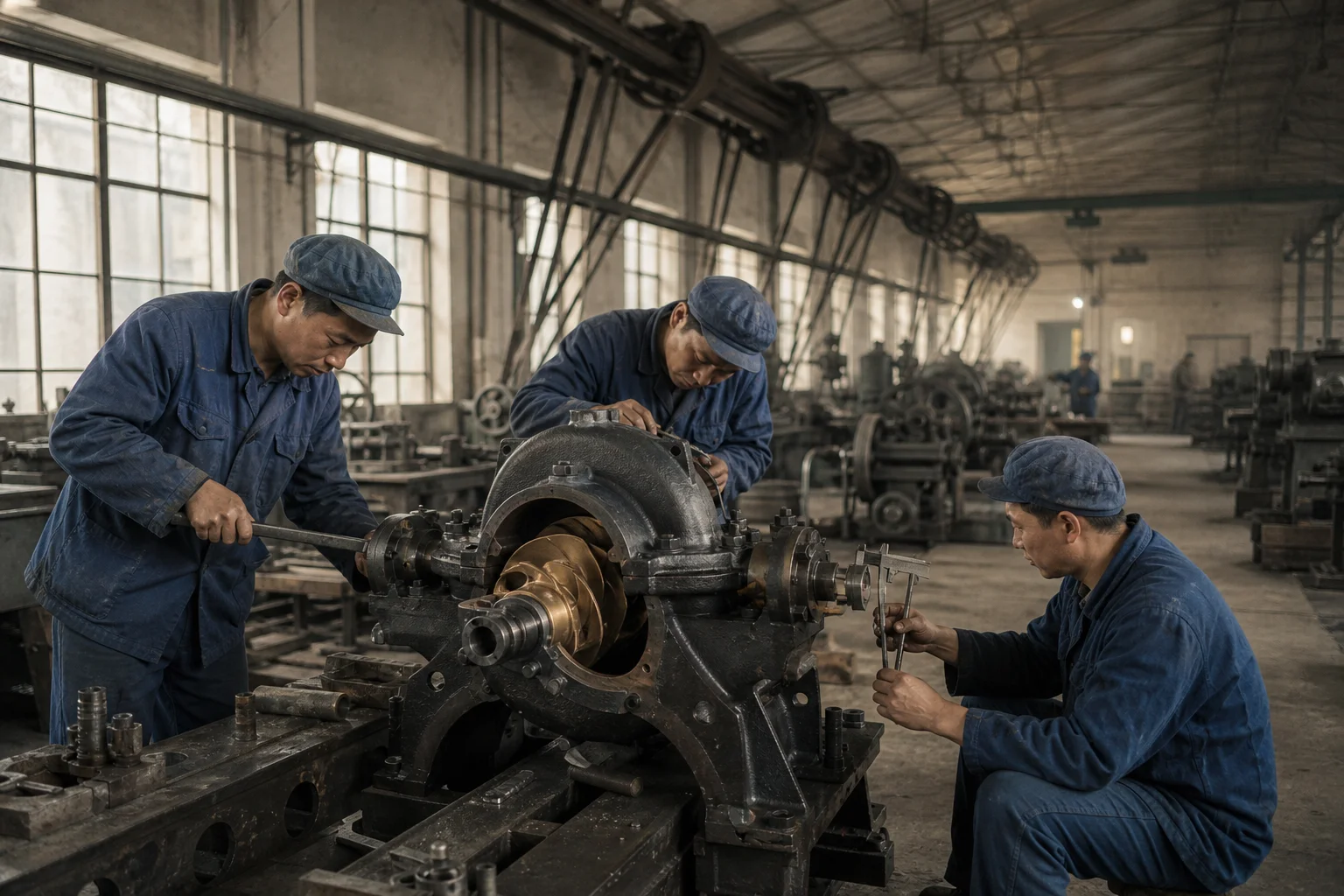
Historical Footsteps of China's Pump Industry
Modern pumps date back to the sliding-vane pump invented by the Italian engineer Ramelli. Since then, pumps have grown to more than 5,000 varieties across 433 years. Pump machine manufacturing - that is, the pump industry itself - has a history of 243 years, beginning in 1790.
For China, pumps and pump manufacturing were introduced from abroad. Even the Chinese character for "pump" (泵) did not exist in ancient times and cannot be found in the Ciyuan dictionary. In the early Qing Dynasty, someone took the "beng" sound of the English word "pump" and, recalling the "beng" sound made when a stone is thrown into water, created the character - a composite of "stone" above and "water" below. It can now be found in the "Supplementary" section of the Kangxi Dictionary.
The period from 1868 to the founding of the People's Republic of China in 1949 is generally regarded as the germination stage of China's pump industry. During that long period, four specialized pump factories appeared on Chinese soil: the Changchun Kuilijin Pump Works, established in 1928; the Beijing Tongyi Water Pump Works, established in 1940; a submersible pump company of the Hong Kong Real Estate Construction Association (Reda), established in 1930; and the Shanghai Qiaxing Pump Repair and Manufacturing Shop, established in 1946, which in its first year surveyed and built China's first 500 mm deep-well pump.
After the founding of the People's Republic, the country entered a three-year period of national economic recovery. Machine works that had produced pumps were quickly brought back into operation - including Dalong, Sanfan, Yonggu, Huachang, Qiaxing and the Shanghai Machine Works in Shanghai; Chunpu in Harbin; Kuilijin in Changchun; Longyou in Benxi; Shenchang in Boshan; Tongyi in Beijing; Kaiming and Zhou Hengshun in Wuhan; Hong'an in Chengdu; and the Shenyang No. 6 Machine Works. In 1951, the Shanghai Machine Works built three 4,250 mm axial-flow pumps and two 3,650 mm mixed-flow pumps for the Lianbinggang irrigation and drainage station in Fujian, turning barren land that had produced no harvest into high-yielding farmland secure against drought and flood.
In 1953, China began large-scale economic construction and implemented its First Five-Year Plan, and the First Ministry of Machine Building and provincial departments and bureaus were established. The management system of China's pump industry was gradually put in place. Fourteen specialized pump plants were set up accordingly, including Shenyang Pump Works, Changsha Pump Works, Harbin Pump Works, Wuxi Pump Works, Foshan Pump Works, Chongqing Pump Works and Shanghai No. 1 Pump Works. The K-series single-stage centrifugal pump, the SM-series multistage pump and the D-series double-suction pump were developed.
After 1957, the First Ministry of Machine Building organized engineers including Zhang Chuanbu to survey pump producers nationwide, and from 1959 began allocating sites and drawing up plans. From 1958 to 1984, the ministry and the provincial machine-building departments and bureaus invested a total of RMB 120 million in industrial pump plants. Of this, RMB 41.353 million was invested in 15 pump plants in 1959: Shenyang, Shanghai, Harbin, Yangquan and Foshan pump works were all rebuilt at new sites, while the Benxi, Dalian, Beijing, Shijiazhuang, Boshan, Lanzhou, Chongqing and Wuhan pump works underwent technical upgrading. This created a certain production scale for general-purpose pumps and made batch production possible. Also at the end of 1959, the national pump industry organization was established in Shenyang, with Shen Kuiyou, director of Shenyang Pump Works, as its head and Su Guyi, director of Changsha Pump Works, as deputy head. Once established, the organization carried out joint industry design, product quality inspection and evaluation, and the formulation of pump industry product standards, accelerating the development of the national pump industry. By the end of the 1960s, there were 50 specialized pump plants and more than 200 part-time pump producers nationwide, with annual output of 582,400 pumps and nearly 1,000 varieties.
To speed up the development and production of pumps for the petroleum, chemical and mining industries, in 1972 the First Ministry of Machine Building and the provincial machine-building departments and bureaus again made large-scale investments in major industrial pump plants, totalling RMB 33.962 million. Of this, Wuhan Pump Works received RMB 10.865 million, Boshan Pump Works RMB 6.44 million, Shenyang Pump Works RMB 4.51 million, Benxi Pump Works RMB 2.237 million and Yangquan Pump Works RMB 1.6 million, while the Shanghai, Shijiazhuang and Tianjin industrial pump works and Baoji Pump Works each received RMB 1 million. This round of large-scale investment and technical upgrading strengthened the research, development and production capacity for petroleum, chemical and mining pumps. The Y-series centrifugal oil pump, the F-series corrosion-resistant pump, the DKS-series oil pipeline pump, the FN molten urea pump, the high-speed partial-flow pump and the mining multistage pump were successively produced and delivered to users.
In that era, the rocket fuel pump developed under the leadership of Lu Jun, a first-class engineer of the 11th Institute of the First Academy, and the water-jet propulsion pump developed under the leadership of Jin Pingzhong, deputy chief engineer of the 8th Institute of the Seventh Academy, both reached advanced international levels. The wear-resistant multistage mine pump of the Tangshan Coal Science Research Institute, the high-pressure water-injection pump of the Taiyuan Coal Research Institute, the high-speed tangential pump of the Hefei General Machinery Research Institute, the bulb tubular pump of the China Institute of Water Resources and Hydropower Research, and the marine pumps of the 4th Institute of the Seventh Academy all reached leading domestic levels. These advances greatly promoted progress in China's professional pump technology. At the same time, agricultural pump manufacturing grew very rapidly throughout the 1970s. China's pump producers increased from 50 at the end of the 1960s to 190 by the end of the 1970s - all of them provincial, prefectural and county-run enterprises or large collective enterprises under the Second Light Industry system.