


Products Description

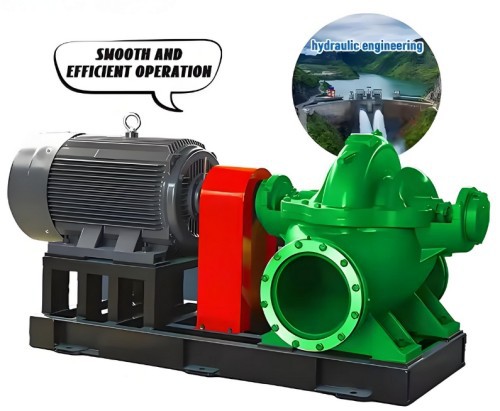
Single-stage double-suction centrifugal pump is also known as single-stage double-suction mid-entry pump. Compared with other pumps, the most obvious feature of this type of pump is its two suction ports. Therefore, this pump usually has a large flow rate.
Single-stage double-suction split-case centrifugal pump is a single-stage double-suction horizontal split-case centrifugal pump, belonging to the power equipment for transporting clear water or media with physical and chemical properties similar to water. This pump is composed of pump body, pump cover, impeller, shaft, sealing ring, shaft sleeve, bearing components, etc. The suction inlet and discharge outlet are arranged below the pump axis. It adopts a horizontal split-case structure design, and during maintenance, the core components can be maintained without disassembling the pipeline.
Related components: shaft, impeller, snap ring, sealing ring, mechanical seal sleeve, sealing body, mechanical seal, sealing cover, water retaining ring, shaft sleeve, bearing body, bearing retaining ring, locking washer, pump cover, key, pin, bearing oil seal, etc.
Also involved are flexible couplings and motors.
Rotation direction of single-stage double-suction centrifugal pump (mid-shaft pump)
From the motor end, the pump shaft rotates clockwise (i.e., the pump inlet is on the right). It can be changed to counterclockwise rotation as needed. Reversing the pump can be indicated by adding the letter F at the end of the pump model.
Assembly process of single-stage double-suction centrifugal pump
1. Disassembly process: Remove the coupling guard → Remove the connecting screws → Remove the control oil pipe → Remove the pump cover screws → Lift off the upper cover → Remove the end shaft seat screws → Remove the impeller shaft from the pump seat → Remove the coupling pump assembly → Remove the key → Remove the snap ring → Remove the bearing body → Remove the bearing sleeve → Remove the water retaining ring → Remove the sealing cover → Remove the mechanical seal → Remove the mechanical seal sleeve → Remove the sealing ring → Remove the positioning ring → Remove the snap ring → Remove the impeller → Remove the key
2. Assembly process: Shaft key → Impeller → Snap ring → Positioning ring → Sealing ring → Mechanical seal sleeve → Mechanical seal → Sealing cover → Water retaining ring → Bearing sleeve → Bearing body → Snap ring → Key → Coupling pump assembly → Impeller shaft into the pump seat → Both end shaft seats → Upper cover → Coupling guard → Control oil pipe
Product basic parameters

| Parts Materials for options |
Casing Materials | Cast iron,Ductile Cast Iron,Cast steel,Bronze,AISI304, 316,316L,Duplex |
| Impeller Materials | Cast iron,Ductile Cast Iron,Cast steel,Bronze,AISI304, 316,316L,Duplex |
|
| Wear Ring Materials |
Cast iron,Cast steel,Bronze,AISI304,316,316L,Duplex | |
| Shaft Material | Carbon Steel,AISI 304,316,316L,Duplex | |
| Shaft Sleeve Material |
Cast Iron,carbon steel,bronze,AIDSI304316L,316,Duplex | |
| Pump Discharge Diameter |
DN | 80-800mm |
| Capacity | Q | Max14400³/h |
| Head | H | Max150m |
| Operating pressure |
P | Max2.5MPa |
| Operating temperature |
T | Max120degree Celsiu |
Product model
| Model | Inlet/Outlet (mm) |
Capacity m³/h |
Head m |
Speed (rpm) |
Shaft power (kw) |
| 200S-95 | 200/200 | 280 | 95 | 2900 | 94 |
| 200S-63 | 200/200 | 280 | 63 | 2900 | 59.3 |
| 200S-42 | 200/200 | 280 | 42 | 2900 | 37.7 |
| 250S-65 | 250/250 | 485 | 65 | 1450 | 108.7 |
| 250S-39 | 250/250 | 485 | 39 | 1450 | 62.1 |
| 250S-24 | 250/250 | 485 | 24 | 1450 | 36.9 |
| 250S-14 | 250/250 | 485 | 14 | 1450 | 21.7 |
| 300S-90 | 300/300 | 790 | 90 | 1450 | 249.8 |
| 300S-58 | 300/300 | 790 | 58 | 1450 | 148.5 |
| 300S-32 | 300/300 | 790 | 32 | 1450 | 79 |
| 300S-19 | 300/300 | 790 | 19 | 1450 | 46.9 |
| 300S-12 | 300/300 | 790 | 12 | 1450 | 31.1 |
| 350S- 125 |
350/350 | 1260 | 125 | 1450 | 531 |
| 350S-75 | 350/350 | 1260 | 75 | 1450 | 304 |
| 350S-44 | 350/350 | 1260 | 44 | 1450 | 177.6 |
| 350S-26 | 350/350 | 1260 | 26 | 1450 | 101.5 |
| 350S-16 | 350/350 | 1260 | 16 | 1450 | 63.8 |
| 500S-13 | 500/500 | 2020 | 13 | 980 | 86.2 |
| 500S-35 | 500/500 | 2020 | 35 | 980 | 219 |
| 500S-98 | 500/500 | 2020 | 98 | 980 | 678 |
Application scenario
The single-stage double-suction horizontal centrifugal pump has the characteristics of reliable performance, low energy consumption, large flow rate, and long service life. Therefore, it has wide application scenarios in industries such as petroleum, chemical engineering, metallurgy, papermaking, power, and mining.
1. Industrial production: For example, in industries such as petroleum, chemical engineering, metallurgy, papermaking, power, and mining, it is often used to convey various liquids and their mixtures, such as corrosive media, oil products, acids, and alkalis.
2. Municipal engineering: For example, in urban water supply, sewage transportation, power plants, port and dock areas, it can be used for industrial drainage, urban tap water, fire-fighting water supply, etc.
3. Agricultural irrigation: For example, in irrigation pumps, drainage pumps, etc., it can be used for crop irrigation, drainage, agricultural and fishery purposes, etc.
4. Other fields: For example, in medicine, food, environmental protection, etc., it is also commonly used for corresponding conveyance.
In conclusion, the single-stage double-suction horizontal centrifugal pump has wide application scenarios in various fields. Its reliable performance and wide range of applications make it an indispensable important equipment in modern industrial production and urban construction.

FAQ

01.How to improve pump efficiency?
1. The efficiency of the pump itself is the most fundamental factor. Under the same working conditions, the efficiency of the pump can differ by more than 15%.
2. The operating condition of the centrifugal pump is lower than its rated condition, resulting in low pump efficiency and high energy consumption.
3. The efficiency of the motor remains basically unchanged during operation. Therefore, choosing a high-efficiency motor is of crucial importance.
4. The influence of mechanical efficiency is mainly related to design and manufacturing quality. After selecting the pump, the later management has a relatively small impact.
5. Hydraulic losses include hydraulic friction and local resistance losses. After the pump has run for a certain period of time, inevitable wear of the surface of the impeller and guide vanes occurs, resulting in increased hydraulic losses and reduced hydraulic efficiency.
6. The volumetric loss, also known as leakage loss, includes three types of leakage losses: the sealing ring of the impeller, the gap between stages, and the axial force balance mechanism. The efficiency of volumetric efficiency is not only related to design and manufacturing but also to later management. After the pump operates for a certain period of time, due to friction between components, the gap increases, and the volumetric efficiency decreases.
7. Due to clogging of the filter cylinder, pipeline air intake, etc., the centrifugal pump becomes empty or runs in idle mode.
8. Before starting the pump, employees do not pay attention to the preparatory work before starting the pump, such as warming up the pump, rotating the pump, and filling the pump, and the basic operating procedures are not carried out thoroughly. This often causes cavitation of the pump, resulting in high noise, vibration, and low pump efficiency.
II. Measures to reduce the energy consumption of centrifugal pumps and improve the efficiency of the pump set
Use high-molecular composite materials for repair and protection:
Energy-saving principle: During the operation of the pump, the water flowing inside the pump is affected by the friction between it and the flow channel and the surface of the pump impeller, as well as the viscosity of the water. The energy consumed by the pump is mainly used to resist the flow friction force and vortex resistance of the water. The energy consumed by the water during its flow (head loss) is used to overcome the internal friction force and the friction force between the water and the equipment interface. If the surface of the pump and the impeller are smooth (such a surface is called a hydrodynamic smooth surface), the surface resistance is small, and the energy consumed is less. By spraying high-molecular composite materials on the over-flow surface and the impeller, a hydrodynamic smooth surface is formed on the surface, with a surface smoothness 20 times that of stainless steel after polishing. This extremely smooth surface reduces the stratification of fluid inside the pump, thereby reducing internal turbulence, reducing volumetric losses and hydraulic losses, reducing power consumption, and achieving the purpose of reducing flow resistance losses, thereby improving the hydraulic efficiency of the pump, and to a certain extent, also improving mechanical efficiency and volumetric efficiency. The density of the molecular structure of the coating can isolate the contact between air, water, etc. and the pump impeller base material, minimizing electrochemical corrosion and rust.
02.How to analyze and diagnose faults?
There may also be leakage channels, but there is usually a primary and secondary distinction. As long as the observation is meticulous and the structure is familiar, the problem can be correctly determined.
2. Leakage during trial operation. After the mechanical seal for the pump has undergone static test, during the high-speed rotation caused by the centrifugal force generated during operation, the leakage of the medium will be suppressed. Therefore, the leakage of the mechanical seal during trial operation, after excluding the failure of the shaft seal and the end cover seal, is mostly caused by the damage to the friction pairs of the moving and stationary rings. The factors causing the failure of the friction pair sealing include:
(1) During operation, due to abnormal phenomena such as vacuum, cavitation, or prolonged pressure build-up, a large axial force is generated, causing the contact surfaces of the moving and stationary rings to separate;
(2) Excessive compression during the installation of the mechanical seal leads to severe wear and scratches on the end faces of the friction pairs;
(3) The moving ring sealing ring is too tight, and the spring cannot adjust the axial floating amount of the moving ring;
(4) The stationary ring sealing ring is too loose, and when the moving ring undergoes axial floating, the stationary ring detaches from the stationary ring seat;
(5) There are granular substances in the working medium, which enter the friction pair during operation, and the sealing ends are inspected by flaw detection;
(6) There is an error in the design or selection, the contact pressure of the sealing end face is too low, or the cold shrinkage property of the sealing material is too large. These phenomena often occur during trial operation, and sometimes they can be eliminated by appropriate adjustments to the stationary ring seat, etc., but most require reinstallation and replacement of the seals.
3. Leakage suddenly occurs during normal operation. For centrifugal pumps, sudden leakage during operation is mostly caused by normal wear or reaching the service life; most of the time, it is caused by significant changes in operating conditions or improper operation and maintenance.
(1) Vacuum, cavitation, or prolonged pressure build-up causes the seal to be damaged;
(2) The actual output of the pump is too small, and a large amount of medium circulates within the pump, causing heat accumulation. The medium vaporizes, leading to seal failure;
(3) The return flow is too large, causing sediment at the bottom of the container (tower, tank, drum, pool) to rise on the suction side of the pump.
It damages the seal;
(4) The pump has been stopped for a long time.
Manual turning of the shaft was not performed during restart.
The friction pair is torn due to adhesion and damage to the sealing surface;
(5) The medium contains more corrosive, polymerizing, or gelling substances;
(6) The environmental temperature changes sharply;
(7) The operating conditions change frequently or are adjusted;
(8) Sudden power outage or machine failure shutdown. If the leakage of the centrifugal pump during normal operation is not detected in time, it may lead to major accidents or losses, and it is necessary to pay attention and take effective measures. Note:
The discovery of problems and the solutions to them all come from daily practical work, just like the internal structure of a single-stage double-suction centrifugal pump. It cannot be fully understood merely by imagination; only by disassembling it and analyzing it based on theoretical knowledge can one master it well.
Understand the functions of each part of the structure and why problems occur.
The most important structure of a single-stage double-suction centrifugal pump is the impeller and the sealing body, which are also the components most prone to failure.
For example, once the shaft seal breaks, there will be problems such as water leakage, and in severe cases, it can damage the equipment, thereby affecting production. Regarding the issue of the shaft, generally, as long as the coaxiality is adjusted properly, there will not be too many problems.
Therefore, very high requirements have been put forward for the working principle and usage method of the dial indicator.
In simple terms, everything depends on the combination of theory and practice, which is indispensable. For the installation of the sealing body, only by doing it yourself can you master the techniques involved.
03.How to install a single-stage double-suction pump?
Basic Parameter Confirmation
Verify the matching degree of the pump model with actual requirements: For example, the lift height needs to cover the terrain height difference + pipeline loss (e.g., irrigation field height difference of 20m, pipeline length of 300m, total lift height ≈ 20m + 15m = 35m, choose the 200S42 model).
Check the completeness of the equipment: Are the pump body, impeller, bearing assembly, sealing components (packing / mechanical seal), coupling protective cover and other accessories complete? Are there any cracks or wear on the surface?
Installation Site Requirements
Foundation Flatness: Horizontal error ≤ 0.5mm/m, use concrete foundation (thickness ≥ 200mm), pre-buried anchor bolts (spacing according to the pump base hole spacing).
Space Reservation: A 1.5-2m maintenance passage needs to be reserved around the pump, and a lifting device should be set above (when the pump weight > 500kg), to facilitate the disassembly of the pump cover and impeller.
II. Core Installation Steps: From Positioning to Trial Run
(1) Pump and Motor Positioning Installation
Base Fixation
Base leveling: Use a level gauge to adjust the levelness of the base (lateral / longitudinal deviation ≤ 0.1mm/m), pre-tighten the anchor bolts first, and then tighten them again after the pump body installation.
Damping Measures: If installed on a mobile pump truck or in a vibrating environment, place rubber damping pads under the base (thickness 5-10mm) to avoid resonance.
Pump Body and Motor Connection
Single-suction Pump Installation: Place the pump body on the base, insert the anchor bolts, do not tighten immediately; lift the motor to the coupling side and initially fix it.
Alignment Calibration (Key!) :
Measure the radial / end face runout of the coupling using a dial indicator (allowable error ≤ 0.05mm). Adjust by adding or removing the motor base gaskets (the gaskets should be ≥ 3 layers, with a total thickness of ≤ 5mm).
Example: The coupling of the 250S65 pump has a diameter of 200mm. When the end face runout exceeds 0.08mm, a 0.1mm copper gasket needs to be added at the bottom of the motor for correction.
(II) Pipeline System Connection
Installation of suction pipe system
Pipe diameter requirements: The diameter of the suction pipe should be greater than or equal to the diameter of the pump's suction port (for example: if the pump's inlet diameter is DN200, the suction pipe should be selected as DN250), and the slope of the pipeline to reduce resistance: uphill towards the pump at a ratio of 1:50 (to avoid air pockets), and it is strictly prohibited to have a "U-shaped" bend; the bottom valve should be at least 1.5 times the pipe diameter away from the bottom of the pool, and at least 0.5 meters away from the water surface.
Filter net configuration: Install a filter net at the suction inlet (with a pore size of ≤ 5mm) to prevent debris from being sucked in (if the cement sand content in the irrigation channel is high, a metal filter net should be selected).
Installation of pressure water pipeline
Check valve and gate valve: Install the gate valve (for convenient flow regulation) and the check valve (to prevent water hammer when the pump stops) in sequence at the outlet, with a distance of at least 5 times the pipe diameter from the pump outlet.
Installation of pressure gauge: Install a pressure gauge before the gate valve at the pump outlet (with a range of 1.5 times the designed head), to monitor the operating pressure in real time.
04.How to conduct regular maintenance for a single-stage double-suction pump?
Replace bearing lubricant: Clean the bearing chamber, rinse with kerosene, and then inject new grease (the model must match the original specification).
Check packing wear: When the wear depth of the packing gasket cover is greater than 2mm, replace it (the material can be selected as vegetable oil packing or carbon fiber packing).
2000 hours (approximately 1 year)
Disassemble the pump for maintenance: Open the pump cover, check the gap between the impeller and the sealing ring (the standard value is 0.15-0.3mm, and if the wear exceeds 0.5mm, replacement is required).
Measure shaft diameter wear: When the wear at the shaft neck is greater than 0.1mm, it can be repaired by electroplating or replaced with a new shaft (for example, for the 200S pump shaft with a diameter of 45mm, the allowable wear is ≤0.2mm).
Long-term inoperative (more than 1 month)
Empty the liquid in the pump: Remove the bottom cover, dry the pump chamber with compressed air to prevent rusting (pay special attention to anti-freezing in winter).
Anti-rust treatment: Apply anti-rust oil to the impeller and shaft surfaces, inject lubricating grease into the bearing chamber, and wrap the entire machine with plastic sheet.
05.Safety Operating Precautions
Shutdown sequence: Close the outlet gate valve → Cut off the power supply → If it is a long-term shutdown, empty the liquid in the pump.
Anti-surge measures: The suction height should be ≤ 5m (for normal temperature clear water), and when the water temperature is > 40℃, the installation height needs to be reduced (calculated according to the NPSH value for cavitation).
06.Important points to consider when purchasing a single-stage double-suction pump
Before choosing a wholesale double-suction pump, it is essential to pay attention to the quality issue. As a high-load and high-speed equipment, if the quality is not up to standard, there may be safety problems such as water leakage and electric leakage. It is recommended to choose double-suction pumps from well-known brands, such as Grundfos Pumps and Ametek Pumps. These brands all have a high quality guarantee.
II. Brand Selection
When choosing a brand, it is advisable to select a brand with a good reputation. These brands usually have a complete after-sales service system, which can provide users with better services. At the same time, brands with good reputations usually have a high market recognition and can meet the needs of users.
III. After-sales Service
When choosing a wholesale double-suction pump, it is necessary to pay attention to the after-sales service. As a high-load equipment, there may be some problems that require maintenance by after-sales personnel. Therefore, when choosing a brand, it is necessary to choose a brand with a complete after-sales service system. This can ensure that during the use of the double-suction pump, timely and effective assistance can be obtained.
IV. Price Selection
When choosing a wholesale double-suction pump, price is also an important consideration. It is recommended to choose double-suction pump products with good cost performance. However, price is only one factor and cannot be the sole criterion. It is necessary to comprehensively consider factors such as quality, brand, and after-sales service, and make a comprehensive judgment.
V. Application Scenarios
Before choosing a wholesale double-suction pump, specific application scenarios need to be considered. Different application scenarios require different double-suction pump products. For example, if it is used for water treatment in the industrial field, a double-suction pump that can withstand high pressure and high temperature needs to be selected. If it is used for water treatment in the household field, a small-sized double-suction pump can be chosen.
Hot Tags: double suction centrifugal pump, China double suction centrifugal pump manufacturers, Engineering Double Suction Volute Pump, High Efficiency Double Suction pump, High Efficient Double Suction Water Pump, High Flow Double suction Pump, Horizontal Split case Irrigation Pump, Mining Urban Farmland Irrigation Water


