Products Description

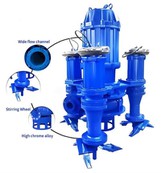
Heavy-Duty Submersible Slurry Pumps When standard centrifugal pumps fail due to abrasive wear or settled solids, the SS Series Submersible Slurry Pump takes over. Unlike vertical sump pumps or horizontal configurations, these units operate fully submerged, eliminating priming issues and handling the toughest abrasive media in mining, dredging, and industrial effluent.

Materials Science: Why We Specify Cr27 (A05) High-Chrome
In abrasive slurry handling, the difference between 2 weeks and 6 months of service life comes down to the metallurgy.
Hardness Standard: We don't just say "hard." Our wet-end parts (Impeller, Volute, Suction Plate) are cast in Cr27. After specialized heat treatment, they maintain a stable HRC 58-62. This specifically counters the "gouging abrasion" caused by sharp silica and iron ore particles.
The Agitator Logic: Standard pumps often fail because the solids settle and "bury" the intake. Our SS series includes an integrated High-Chrome Agitator. It creates a localized "mini-cyclone" to lift settled sludge back into suspension. Note: This is critical for high SG (Specific Gravity) tailings where the solids-to-water ratio exceeds 40%.
Casting Density: We use vacuum casting for the volutes to eliminate internal air pockets. This prevents "localized pitting" which is often the precursor to full casing failure in high-pressure setups.
Operational Advantages: Solving the "Suction Lift" Headache
For site managers, the SS Submersible is a "problem solver" for pits where horizontal pumps are too complex to install.
Zero Priming Required: Forget foot valves and vacuum assist systems. The pump is submerged; the pressure is positive from the start.
Motor Protection (The "Triple Seal" System): We use a dual mechanical seal setup with a dedicated oil chamber. We've added a moisture probe (leakage sensor) inside the chamber. If the primary seal is compromised by fine grit, the sensor alerts the control panel before the liquid hits the motor windings.
Space & Mobility: No need for a concrete foundation. You can hang the unit from a barge or move it between settling ponds with a mobile crane.


Application Spectrum: Mining, Dredging, and Industry
We've seen these units deployed in environments that would destroy a standard sewage pump in hours:
Sand & Gravel Mining: Handling sharp-edged river sand.
Steel Scale Pits: Removing heavy mill scale that settles quickly.
Thermal Power Plants: Pumping bottom ash from discharge sumps.
Port Dredging: Cleaning out harbor silt and organic sludge near docks.

Technical Selection (Critical Engineering Notes)
Don't just pick a pump based on the pipe size. Here's what we look at during the RFQ process:
Slurry Density (SG): If you're pumping 1.3 SG slurry, your motor will draw significantly more current than on water. We oversized our motors by 15-20% to prevent nuisance tripping.
Critical Velocity: To keep solids moving, you need to maintain roughly 2.0 m/s velocity in your discharge pipe. If your pipe is too wide, the sand will drop out and clog your line.
Submergence Depth: Standard units are good for 20m. For deep-pit dredging, we offer reinforced motor housings capable of 30m+ submersion.

Selection & Engineering: Beyond Flow and Head (Extended Knowledge)
To ensure a slurry pump lasts more than a few weeks, the selection must go beyond basic water hydraulics:
Specific Gravity (SG) Correction: A pump rated for 20m of water will NOT reach 20m with a slurry of 1.3 SG. We calculate the "Required Head" by accounting for the slurry density to prevent motor overload.
Critical Velocity Calculation: If the slurry moves too slowly in the discharge pipe, solids will drop out of suspension and block the line. We recommend a pipe velocity of 1.5–2.5 m/s depending on particle size.
Settling Velocity vs. Agitation: For heavy particles like iron ore tailings, the agitation radius of the pump must be matched to the pit size to ensure complete solids recovery.
FAQ

01.How do I know if I need an agitator or if a standard strainer is enough?
02.What is the maximum particle size these pumps can handle?
03.Can I run the pump when it is only partially submerged?
04.How often should I replace the wear parts (Impeller/Volute)?
05.Why is my pump producing the rated head but very little flow?
06.What voltage options are available for international mine sites?
One-stop expert for customizing Chinese pump manufacturing services
Our address
Baoding Cloud Center, Hebei, China
Phone Number
+86 150 7625 8596
admin@jovidiapump.com

Hot Tags: heavy-duty submersible slurry pumps, China heavy-duty submersible slurry pumps manufacturers, Hydraulic Submersible Slurry Pump, Submersible Sand Dredging Pump, Stainless Steel Submersible Pump, submersible pump for slurry purification, submersible pump for slurry thickening, multistage slurry pump