What are the differences between axial flow pumps and centrifugal pumps?
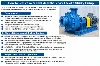
Axial flow pumps are widely used in vertical axial flow pumps. This type of pump is characterized by a large flow rate and low head, and can convey clear water, rainwater, sewage, and other liquid media similar to clear water at temperatures below 40℃. Vertical axial flow pumps are mainly composed of the pump body, guide vanes equipment, and inlet and outlet pipes. The shape of the pump body is cylindrical, and the impeller is fixed on the pump shaft. The pump shaft is supported by two bearings within the pump body, and is connected to the motor drive shaft through a top coupling.
Compared with centrifugal pumps, axial-flow pumps have the following advantages:
The head increases sharply as the flow rate decreases. Backflow occurs at the inlet and outlet of the impeller blades. The water repeatedly gains energy, similar to multi-stage pressurization. As a result, the head increases sharply, leading to an increase in shaft power.
In pump samples, the required head margin for axial flow pumps is generally larger. It is necessary to consider the water intake conditions of the axial flow pump, the actual operating conditions during operation, and the degree of deviation from the planned operating conditions of the pump.
The work scale is very small. Once the flow rate deviates from the planned working conditions, the efficiency will rapidly decline. According to the characteristics of axial flow pumps, generally, the performance curve can only be changed by altering the angle of the impeller. What are the characteristics of the axial flow pump impeller?
The axial flow pump equipment is mainly composed of the pump body and submersible motors. The motor and the pump head are coaxially arranged and form a single unit. The motor and the pump are separated by a mechanical seal to ensure a good seal for the entire motor. The entire motor is submerged in water.
The axial flow pump is equipped with leakage and temperature rise protection devices, ensuring safe and reliable operation. It has a wide range of head variation capabilities. It is widely used in agricultural water facilities, light sewage discharge and water supply projects. It is particularly suitable for situations where the variation range of flow and head is large.
The impeller is an important component for determining the performance of an axial flow pump. The impeller of an axial flow pump has no front or rear cover plates. The impeller is usually composed of blades, a hub, a guide cone, etc. The blades of the semi-adjustable impeller are fixed on the hub with nuts and locating pins. The root of the blades is marked with a baseline, and several locating lines of different installation viewpoints are engraved on the hub. Insert the locating pins and install the impeller. Each viewing point for blade adjustment should be equal; otherwise, the axial flow pump will vibrate during operation.